Trump Slaps Tariffs on Steel and Aluminum; Tariff Threats Have Boosted Claudia Sheinbaum’s Popularity

On March 6th, President Trump called off tariffs on Canada and Mexico. But on March 12th, Trump slapped tariffs on imports of steel and aluminum, including Canada and Mexico.

From Mexico News Daily : “Mexico got a concession on tariffs from United States President Donald Trump last week, but it couldn’t avoid duties on the steel and aluminum it exports to its northern neighbor. The United States on Wednesday [March 12th] imposed 25% tariffs on all steel and aluminum imports, as per an executive order Trump signed on Feb. 10. The tariffs — imposed on national security grounds — also apply to hundreds of products made with those metals, including nuts and bolts, bulldozer blades and soda cans…Mexico and other countries tried to get an exemption to the duties but were unsuccessful.

Mexico News Daily reports that “Mexico is the world’s second largest exporter of steel, aluminum and products derived from those metals to the United States, according to 2024 data from the U.S. Department of Commerce. The value of those Mexican exports to the U.S. was US $34.83 billion last year, second only to China. Most of that amount, however, came from the export of products derived from aluminum and steel. Mexico’s exports of steel itself to the United States were worth US $3.5 billion last year, while aluminum shipments generated revenue of $397 million.

IMCO, the Instituto Mexicano para la Competitividad A.C. (Mexican Institute for Competitivity provides more detailed information. From Mexico News Daily:
According to the Mexican Institute for Competitiveness (IMCO), a Mexico City-based think tank, the United States’ steel and aluminum tariffs will impact 4.7% of all Mexican exports.  Mexico’s exports of steel, aluminum and derivative products collectively contributed to 1.56% of Mexico’s GDP in 2024, the think tank said...IMCO noted that auto parts, domestic appliances and electronic products manufactured in Mexico will be affected by the tariffs. The manufacture of those products is “crucial” to the industrial sectors of at least 11 Mexican states, the think tank said. IMCO calculated that the new 25% tariffs — if they had been in effect in 2024 — would have affected Mexican goods worth US $22.53 billion.”

The figure is lower than the total value of Mexico’s steel and aluminum exports to the United States last year because the new tariffs only apply to the steel and aluminum content of a product partially derived from those metals, not the entire product. In addition, United States steel and aluminum used in products exported to the U.S. are not subject to the 25% tariffs.”

Among the Mexican products that are subject to the new tariffs, IMCO listed those that generated the most revenue as a result of their shipment to the United States last year.”

The list includes automobile parts, air conditioner parts, telephone parts, metal furniture, refrigerator and freezer parts, machines and electrical devices.

IMCO noted that Mexico’s auto industry, ‘one of the country’s main export sectors,’ will be ‘directly’ impacted by the tariffs.”

On another note, USA Today reports that Trump’s tariff threats have boosted the public approval of the leadership of Canada and Mexico: “Approval ratings for Canadian and Mexican leaders are skyrocketing amid popular outrage in those countries over President Donald Trump’s tariff threats − as his own approval ratings have slipped among Americans…Mexican President Claudia Sheinbaum’s approval ratings are sky high – 85% approve of her, while just 15% disapprove – the highest approval rating of any Mexican president in the last three decades, according to a poll from El Financiero conducted from Feb. 13 to 17 and Feb. 20 to 24. In Canada, the ruling Liberal Party hadn’t led in national polls since February 2021. Now, according to a recent Ipsos survey, they lead the opposition Conservatives, 38% to 36% [There are polls showing the Liberals ahead, other polls, however, show a tie or Conservatives leading, it’s close.]….support for the country’s Liberal Party surged late last month, after Trump’s tussle with the country. The Liberals wiped out a 26-point Conservative Party lead within six weeks…A Leger poll taken from Feb. 28 to March 2 found 85% of Canadians reject Trump’s annexation proposal.”

In the Canadian province of Ontario, Progressive Conservative Premier (Governor) Doug Ford won reelection on February 27th. Ford has taken the lead in opposing Trump tariffs and has been called “Captain Canada”.

Canada in red, U.S. in blue, Mexico in green. Freepik.com

Posted in Economy, Foreign Policy | Tagged , , , , , , , , | 1 Comment

LiDAR Technology Shows that Guiengola Was Much Larger Than Previously Thought

Guiengola is a Zapotec archaeological site located in the southern Mexican state of Oaxaca (wa-ha-ka).

State of Oaxaca in red. Source: TUBS

The Guiengola site was a fortification constructed between the 1300s and 1500s, providing protection from the Aztec Empire. The Aztecs never took the fortress, which was later abandoned.

The site includes a couple of pyramids, a palace, a ball court and tombs.

Previously-discovered Guiengola. Source: Pedro Guillermo Ramón Celis

Now, thanks to LiDAR technology, it’s been found that Guiengola was much larger than previously thought.

LiDAR stands for Light Detection and Ranging. It uses laser pulses fired from aircraft that bounce off the ground and back to the aircraft, revealing the relief of the ground area being studied. A previous Mexico News Report article reported how a lost Maya city was discovered using LiDAR.

Regarding Guiengola in Oxaca, here is information from Newsweek: “Pedro Guillermo Ramón Celis of McGill University in Montreal, Canada revealed the true extent of forest-covered Guiengola using a laser-based scanning technique, flying over the site in an airplane. His study has revealed that the fortified city covers a whopping 360 hectares [about 890 acres] and sported more than 1,100 structures—including temples, ball courts and different neighborhoods for the commoners and the elite—and 2.5 miles of walls. ” 

LiDAR scan of Guiengola. Source: Pedro Guillermo Ramón Celis

‘Because the city is only between 500 and 600 years old, it is amazingly well preserved,’ Ramón Celis said in a statement. ‘You can walk there in the jungle, and you find that houses are still standing—you can see the doors, the hallways, the fences that split them from other houses.’ ” 

“According to Ramón Celis, evidence suggests that the fortified city was abandoned just before the Spanish arrived in Mexico—with its residents relocating to nearby Tehuantepec, a small city where their descendants still live.”

“By the end of the 15th century, Ramón Celis told Newsweek, the Zapotecs had managed to both gain almost total control of Oaxaca’s Pacific Coat, and had resisted the aggressive Late Postclassic expansion of the Mexicas (the Aztec Empire).” 

‘This was especially remarkable following a lengthy, seven-month siege, led by Aztec emperor Ahuizotl, at Guiengola,’ he noted.” 

‘After securing this region of southern Mesoamerica, the Zapotecs no longer needed to inhabit this city.’ ” 

” ‘While living in a mountainous area had its advantages, access to running water and more fertile land were likely more important for a large population, and the site of Tehuantepec had this advantage over Guiengola.’ ” 

Guiengola, he added, is ‘like a city frozen in time, before any of the deep cultural transformations brought by the Spanish arrival had taken place.’ ” 

Ramón Celis has a family connection to the region.

” ‘My mother’s family is from the region of Tehuantepec, which is around 20 km [12 miles] from the site, and I remember them talking about it when I was a child,’ Ramón Celis explained. ‘It was one of the reasons that I chose to go into archaeology.’ ” 

It would have been hard to find it without LiDAR.

” ‘Although you could reach the site using a footpath, it was covered by a canopy of trees,’ the archaeologist explained. ‘Until very recently, there would have been no way for anyone to discover the full extent of the site without spending years on the ground walking and searching.’ ” 

” ‘We were able to do it within two hours by using remote sensing equipment and scanning from a plane.’ ” 

So now what’s the plan?

” ‘Currently, I’m planning my fourth field season, during which my team and I will cover all the approximately 1,170 structures in the LiDAR scan, which will take us a few years,’ Ramón Celis said, stressing that this work will involve further remote sensing, rather than physical excavations of the site.” 

Posted in Archaeology | Tagged , , , , , , , | 1 Comment

Cabinet Profile: Mario Delgado, Secretary of Education

Mario Delgado Carrillo serves as Secretary of Education (Secretario de Educación Pública) in the cabinet of Mexican President Claudia Sheinbaum.

Mario Delgado. Source: flickr.com

The official title of the department in Spanish is the Secretaría de Educación Pública (SEP), the Secretariat of Public Education.

SEP Symbol. Source: Government of Mexico

Mario Delgado Carrillo was born in 1972 in Colima, capital city of the state of the same name on the Pacific coast of Mexico.

State of Colima in red. Source: TUBS

From 1991 to 1995, Mario Delgado studied at the Instituto Tecnológico Autónomo de México (ITAM) in Mexico City, earning a bachelor’s in economics. After that Delgado studied at the University of Essex, in England, from 1996 to 1997, earning a master’s degree in economics.

When Marcelo Ebrard served as mayor of Mexico City from 2006 to 2012, Mario Delgado served in the Mexico City government as Secretary of Finance (2006-2010) and Secretary of Education (2010-2012).

From 2012 to 2018, Delgado was a senator in the Mexican Congress.

From 2018 to 2020, Delgado represented Mexico City in the Mexican Congress, where he was coordinator of the MORENA party delegation in the Chamber of Deputies (Mexican House of Representatives).

From Nov. 5th, 2020 to September 30th, 2024, Delgado was president of the MORENA party.

On October 1st, 2024, Claudia Sheinbaum became President of Mexico and on that day Mario Delgado became Mexico’s Secretary of Education.

Posted in Politics | Tagged , , , , , , , , , , , , | Leave a comment

Trump Calls Off Tariffs on Mexico and Canada

On March 4th, 2025, President Donald Trump of the U.S. slapped tariffs on Mexico, Canada and China.

Two days later, Trump removed the tariffs on goods not covered by the USMCA pact, at least for a month, from Mexico and Canada. Goods not covered by USMCA are still subject to the new tariffs.

Canada in red, U.S. in blue, Mexico in green. Source:Freepik.com

From NPR: “Two days after putting 25% tariffs on goods from Mexico and Canada, President Trump said on Thursday [March 6] that he will largely lift them — the latest twist in his on-again, off-again approach to an issue that has sent markets into a tailspin.”

“Trump started to tap the brakes on the tariffs on Wednesday [March 5th], after talking to the Big Three U.S. automakers. And then after a conversation  with Mexican President Claudia Sheinbaum on Thursday [March 6th], he said on social media that he would give a break to all Mexican goods covered by the United States-Mexico-Canada Agreement (USMCA).”

“A few hours later, he signed executive orders that included relief for Canadian goods covered by the USMCA.”

Trump has a plan for April 2nd.

The reprieve will last until at least April 2, when Trump plans to begin reciprocal tariffs on goods from a wider range of countries. The rates, products and countries affected by the upcoming reciprocal tariffs are still to be determined.

“Canada and Mexico may avert the 25% tariffs beyond April 2 if they show they have made more progress curbing fentanyl trafficking, a senior administration official told reporters on a conference call ahead of the signing, speaking on condition of anonymity.”

What Trump plans for March 12th: “Trump told reporters that separate tariffs on steel and aluminum will go into effect as planned, on March 12.”

What Mexican President Sheinbaum said about her phone conversation with Trump: “Sheinbaum described her phone call with Trump as ‘respectful.’ She said she walked Trump through a set of his own government’s statistics showing a huge drop in the amount of fentanyl being seized by border authorities.”

President Sheinbaum at her press conference, March 6th. Source: Alfredo Estrella

Posted in Economy, Foreign Policy | Tagged , , , , , | Leave a comment

Trump Slaps Tariffs on Mexico, Canada and China; Lutnick’s Comment

On March 4th, 2025, President Trump of the U.S.A. slapped tariffs on Mexico, Canada and China.

Canada, Mexico and China in red. Source:www.mapchart.net

From the Wall Street Journal: “President Trump’s 25% tariffs on goods from Mexico and Canada took effect first thing Tuesday [March 4]. Canada responded with plans to impose 25% tariffs on about $100 billion of U.S. imports, with Prime Minister Justin Trudeau saying Trump is acting in ‘bad faith’ and the U.S. president threatening more tariffs. Mexico’s president said it would also retaliate, with a range of moves to be announced Sunday [March 9th]. The U.S. also introduced an extra 10% tariff on Chinese imports overnight, adding to a levy imposed a month ago, and other existing duties. China swiftly announced retaliatory tariffs on U.S. agricultural goods, and other measures against American companies. Beijing also filed a lawsuit with the World Trade Organization .

The Associated Press reported this detail: “Later in the day, Commerce Secretary Howard Lutnick said the U.S. would likely meet Canada and Mexico ‘in the middle,’ with an announcement coming as soon as Wednesday [March 5]. Lutnick told Fox Business News that the tariffs would not be paused, but that Trump would reach a compromise.”

Posted in Economy, Foreign Policy | Tagged , , , , , , | 1 Comment

Mexican Relations with Ukraine and Russia

The tragic war between Russia and Ukraine continues. What involvement does Mexico have with these two countries and the war?

On March 2nd, 2022, in the United Nations, 141 nations, including Mexico, voted to condemn Russia’s invasion of Ukraine. Only 5 countries voted against the resolution and 35 abstained.

Nevertheless, the Mexican government refused to join in with sanctions against Russia. According to then-President AMLO, “We do not consider that is our role and we think that the best thing is to promote dialogue to achieve peace.” [AMLO Press Conference, March 1st, 2022]. AMLO explained that Mexico wouldn’t “take any reprisal of an economic type” and wants “good relations with all the governments of the world.”

Later, then-Foreign Minister Marcelo Ebrard said that Mexico would only put sanctions on Russia if the UN Security Council would apply them, an unlikely event because Russia is on the council and has veto power.

Mexico has trade relations with both Ukraine and Russia, but its trade with Russia dwarfs its trade with Ukraine.

Most Third World countries did not join in with sanctions against Russia.

At the same time as the UN resolutions and the sanctions, six representatives in Ukraine’s parliament attempted to obtain weapons from Mexico. Oksana Dramaretska, Ukrainian Ambassador to Mexico, delivered their letter to request the Mexican Congress to send arms: “anti-tank guided missiles, FIM-92 Stingers, small arms, grenade launchers and other ammunition (modern and Soviet origin), all kinds of communication apparatuses, principally portable military radio apparatuses, ballistic vests and helmets.” The letter also asked Mexico to lobby Europe for combat aircraft.

Mexico refused. “We do not send arms anywhere. We are pacifists” said AMLO.

After Russia’s full-scale invasion, February 24th, 2022, Mexico organized an evacuation of Mexicans from Ukraine. They were flown out from Romania and arrived on a Mexican air force plane on March 4th, 2022. There were 81 evacuees consisting of Mexicans and family members of Mexicans: 44 Mexicans, 28 Ukrainians, 7 Ecuadorians, a Peruvian and an Australian.

That was three years ago, in 2022, the year of the full-scale Russian invasion.

Mexico has continued to trade with both countries. However the value of both exports and imports, to and from both Ukraine and Russia, have greatly diminished. See the charts below.

MEXICAN-UKRAINIAN TRADE

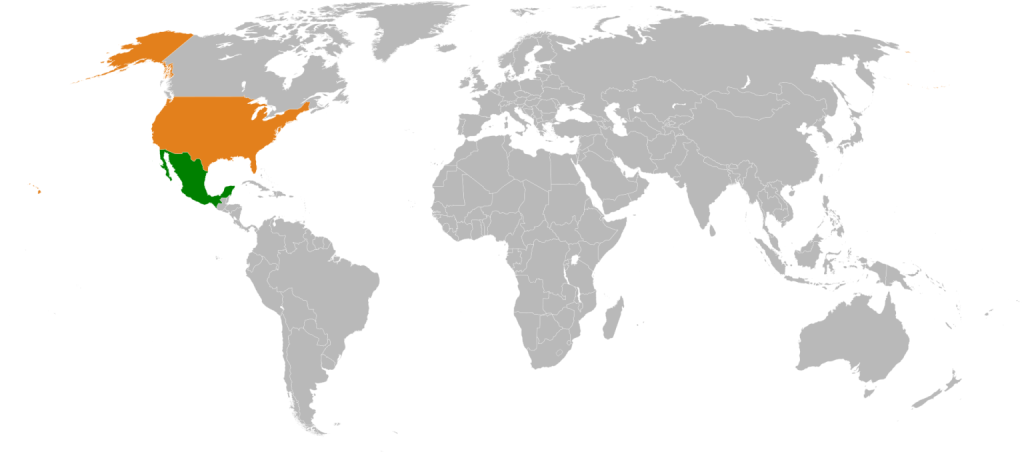
Mexico in green, Ukraine in orange. Source:Groubani

Value of Mexican Exports to Ukraine in U.S. Dollars:
2021 – 37.6 Million
2022– 12.3 Million
2023– 8.24 Million
2024– 13.5 Million
Value of Mexican Imports from Ukraine:
2021– 302 Million
2022– 113 Million
2023– 116 Million
2024 – 87.6 Million

MEXICAN-RUSSIAN TRADE

Mexico in green, Russia in orange. Source: Groubani


Value of Mexican Exports to Russia in U.S. Dollars:
2021 – 499 Million
2022– 122 Million
2023– 36.9 Million
2024– 28.4 Million
Value of Mexican Imports from Russia:
2021– 2 Billion, 251 Million
2022– 2 Billion, 328 Million
2023– 2 Billion, 150 Million
2024– 1 Billion, 581 Million

Posted in Economy, Foreign Policy | Tagged , , , , , , , | 1 Comment

China’s Economic Ties with Latin America (Including Mexico)

In recent years Chinese economic ties in Latin American countries have increased greatly.

China (left in red) and the Western Hemisphere (right in red). Source: mapchart.net

Brenda Estefan is a writer for Mexico’s Reforma newspaper and also a professor at IPADE Business School in Mexico City. (IPADE, Instituto Panamericano de Alta Dirección de Empresa, is the business school of Universidad Panamericano, a private Mexican university.)

Brenda Estefan.
Source:Americas Quarterly

Professor Estefan has an article on the China/Latin America topic in the America’s Quarterly, entitled Latin America’s China Ties Won’t Be Easily Severed .

Estefan writes that “Over the past two decades, while the U.S. focused on the War on Terror and conflicts in Iraq and Afghanistan, China strategically expanded its economic presence in Latin America and the Caribbean, transforming from a peripheral player into a key trading partner. Former U.S. Treasury Secretary Larry Summers acknowledged that he underestimated  this shift: ‘When a Latin American head of state asked me for something, I lectured them. While I was preaching, the Chinese were building airports.’ ”

Source: Americas Quarterly

Here’s how Estefan presents the big picture: “China has established a significant presence in many nations across the Western Hemisphere by lending to countries in urgent need, donating public libraries, building ports and roads, and extracting iron ore and vital minerals. Furthermore, trade between China, Latin America, and the Caribbean soared from $12 billion in 2000 to $315 billion in 2020, with projections indicating it could surpass $700 billion by 2035. China is now South America’s largest trading partner, with Brazil’s trade with China exceeding its trade with the U.S. by more than two to one. Beijing currently maintains ‘strategic partnerships’ with 10 of the 11 South American nations it engages with, with Guyana being the only exception, as it maintains only standard bilateral relations.

Here is some information from the article about individual Latin American countries and their China relationship, concluding with Mexico:

COLOMBIA – “Seen by many as the staunchest and most loyal U.S. ally in the region, the U.S. is Colombia’s top trading partner, in contrast to the several South American countries whose largest trading partner is China. Still, Chinese imports have surged in recent years, making the Asian behemoth the country’s second-largest trade relationship.

BRAZIL – “…Brazil—Latin America’s largest economy—is largely a lost cause for Washington, as it has significantly deepened its ties with Beijing. Chinese firms have invested in major infrastructure projects ranging from ports and railways to power grids. China is now Brazil’s largest trading partner, absorbing most of its exports, including soy, beef, coffee, and iron. In 2023, bilateral trade reached a record $181 billion. Moreover, Brazil and China have strengthened their geopolitical ties through BRICS, further complicating Washington’s ability to exert influence.”

ARGENTINA- “In Argentina, President Javier Milei presents a unique dynamic. While he shares a strong ideological affinity with Trump, his country’s economic ties to China—especially in the agricultural sector—are significant. The relationship between Argentina and China developed gradually between the 1970s and 2009, culminating in a major financial agreement: a currency swap between the Central Bank of Argentina (BCRA) and the People’s Bank of China (PBOC). The goal was to ensure Argentina’s exchange rate stability and strengthen bilateral trade. Since then, economic cooperation has deepened, with China becoming Argentina’s largest buyer of agricultural products.”

PERU- “Peru attracts the highest level of Chinese investment relative to GDP in Latin America. The most recent—and largest—of these investments is the Chancay deep-water port, designed to serve as a direct trade link between China and South America…”

CHILE – “Over the past seven years, Chinese investment in Chile has surged by 1,300%, with notable acquisitions in strategic sectors. Chinese firms now control over 60% of Chile’s electricity distribution market following purchases like Chilquinta and General Electricity Company (CGE).”

PANAMA “Following a visit by U.S. Secretary of State Marco Rubio, President José Raúl Mulino announced Panama’s withdrawal from China’s Belt and Road Initiative and indicated that his government might reconsider the concession granted to Hong Kong-based Hutchison Ports, which operates key terminals at both ends of the interoceanic canal.”

MEXICO
Mexico is one of Washington’s most significant cases, given its deep economic integration with the U.S. through the USMCA. A recent article in The New York Times highlighted that China’s growing presence in Mexico’s auto industry is a key factor driving Trump’s push to expedite the USMCA trade agreement review. Since 2018, Chinese investment in Mexico has surged by 50% annually. In 2024, Mexico became China’s second-largest auto market, surpassed only by Russia. Manzanillo, the country’s busiest port, has seen a substantial rise in imports since 2020, mainly driven by Chinese goods. According to Norwegian logistics firm Xeneta, the Mexico-China trade route is now the fastest-growing in the world. Chinese companies have also played pivotal roles in major infrastructure projects in Mexico, including the Xochimilco-Tasqueña light rail and metro system upgrades in Mexico City and Monterrey. Even more, a recent study by Rice University’s Baker Institute suggests that Chinese investment in Mexico may be ten times higher than official figures indicate.

Trump understands that China’s presence in Mexico doesn’t technically violate USMCA terms, but that won’t alleviate his concerns. The idea of his primary geopolitical rival being deeply embedded in his largest trading partner—and positioned just across the 3,000-kilometer U.S.-Mexico border—is unacceptable. Unlike other Latin American nations, Mexico’s trade relationship with the U.S. is not merely important—it is fundamental to its economy, making it more vulnerable to Washington’s efforts to curb Beijing’s influence.

Posted in Economy, Foreign Policy | Tagged , , , , , , , , , , , , , , , | 1 Comment

Cabinet Profile: Alicia Barcena, Secretary of Environment

Alicia Barcena serves as Secretary of Environment (Secretaria de Medio Ambiente) in the cabinet of Mexican President Claudia Sheinbaum.

Alicia Barcena. Source: SEMARNAT

The official title of the department in Spanish is the Secretaría de Medio Ambiente y Recursos Naturales, SEMARNAT), the Secretariat of the Environment and Natural Resources.

SEMARNAT symbol. Source: Government of Mexico

The person heading the department is the Secretaria de Medio Ambiente y Recursos Naturales, the Secretary of Environment and Natural Resources.

According to Mexico’s LEY ORGÁNICA DE LA ADMINISTRACIÓN PÚBLICA FEDERAL (Organic Law of the Federal Public Administration), the goal of SEMARNAT
is to “Promote the protection, restoration, conservation, preservation and sustainable exploitation of the ecosystems, natural resources, and environmental goods and services; with the goal of guaranteeing the right to a healthy environment

Alicia Barcena was born in 1952 in Mexico City. She studied at UNAM (Universidad Nacional Autónoma de México ) where she received a bachelor’s degree in biology. She studied at Harvard from 1983 to 1985, earning a master’s in public administration.

From 1988 to 1991, Barcena was director of Mexico’s National Fisheries Institute.

Beginning in 1995, Barcena served in various posts in the United Nations.

From 2008 to 2022, she was Executive Secretary of the United Nations Economic Commission for Latin America and the Caribbean (ECLAC).

From 2022 to 2023, she was Mexico’s ambassador to Chile.

From July 2023 to October 1st, 2024, she was Mexico’s Foreign Minister.

On October 1st, 2024, she became Secretary of Environment in the administration of Claudia Sheinbaum which took office that day.

Posted in Politics | Tagged , , , , , | Leave a comment

Cuatro Cienegas Basin Seen From Space

Cuatro Cienegas is located in the state of Coahuila in northern Mexico. In Spanish you might see it written as one word (Cuatrociénegas) or two (Cuatro Ciénegas). 

It’s an interesting area. Cuatro Ciénegas means “Four Marshes”. In current scientific terminology, a cienega is a special kind of marsh which exists only in Mexico and the Southwest U.S.

The Cuatro Cienegas area has 150 endemic species of plants and animals, including 3 endemic turtles and 8 endemic fish.

In the city you can visit the house of famous son Venustiano Carranza, considered the Father of the Mexican Constitution.

Outside the city there are natural pools, including the Poza Azul (the blue pool) and the La Poza de la Becerra (Pool of the Calf). You can also visit Las Dunas de Yeso, “the Dunes of Plaster”.
Here is a photo I took of the Blue Pool:

Blue Pool in Cuatrocienegas Basin. Source: Allan Wall, 2019

And here is a photo taken from space of the Cuatro Cienegas Basin. You can see several pools:

Cuatro Cienegas Basin photographed from space. Source: NASA


Posted in Geography, Tourism and Travel, Wildlife | Tagged , , , , , | Leave a comment

Chinese/Mexican “Dragon Cartel” Moves “Cocaine of the Sea” Through Vancouver Port in Exchange for Fentanyl Ingredients

You can’t make this stuff up.

Mexican and Chinese criminals have teamed up to form a new criminal organization – the “Dragon Cartel”, which is moving the “cocaine of the sea” (the swim bladder of the endangered totoaba fish) through Vancouver and other Canadian ports in exchange for fentanyl precursor chemicals.

Totoaba. Source: National Oceanic and Atmospheric Administration (U.S.)

The totoaba fish is endemic to Mexico’s Sea of Cortes (also known as the Gulf of California or the Vermilion Sea), which lies between the Mexican mainland and the Baja California peninsula.

The totoaba is endangered and has been prohibited from being fished since 1975. But that hasn’t stopped poachers from continuing to catch it.

The totoaba swim bladder is in high demand in China and elsewhere in Asia. It’s consumed as a food, and used in traditional medicine and cosmetics. Totoaba swim bladders can fetch tens of thousands of dollars per kilogram.

Totoaba Swim Bladder. Source: Environmental Investigation Agency on Mongabay

The totoaba trade is so lucrative that the fish is called the “cocaine of the sea”, fetching tens of thousands of dollars per kilogram.

This in turn has almost led to the extinction of another endemic Sea of Cortes species, the vaquita, a type of porpoise. Vaquitas get entangled in nets intended for the totoaba and, being mammals, they drown if they’re underwater too long. (See Can Mexico’s Vaquita Porpoise Survive?)

The Canadian Broadcasting Corporation (CBC), has a recent report on this lucrative international criminal enterprise.

A CBC article, by Michelle Ghousoub, is entitled How Mexican cartels and Chinese criminal networks are moving ‘cocaine of the sea’ through Canadian ports.

Here’s how the article explains it: “Chinese organized crime networks and Mexican cartels are using Canadian ports to trade highly lucrative fish bladders for the precursor chemicals needed to produce fentanyl, according to a memo from the Canada Border Services Agency (CBSA). It said organized criminal networks transport the fish — called totoaba — from the West Coast to China, while the chemical precursors to make toxic drugs are sent through Canadian ports.  The report from the CBSA, first obtained by Radio-Canada through a freedom of information request, said Canada is being used as a ‘transit point’ for the illegal product — though the quantity of fish passing through Canada and the amount of fentanyl precursors being exchanged for it, were not included in the report.  The document, originally published in French in October of 2024, says, ‘Chinese organized crime, in collaboration with Mexican cartels, facilitates the illicit movement of totoaba. Illicit wildlife trafficking networks are of a poly-criminal nature and engage in serious criminal behaviour.’

What does “poly-criminal mean?

“Poly-criminal groups refer to networks that traffic more than one illicit commodity, such as counterfeit goods or illicit drugs.”

“The CBSA report indicates that a new criminal network known as the ‘Dragon Cartel,’ comprised of Chinese and Mexican nationals, has been created to deal specifically with totoaba trafficking. The seven-page document says western ports are a target, and that ‘people in Canada regularly engage in the illicit import, export and breeding of protected species.’ ”

Vancouver, Canada’s biggest port, is important in this criminal endeavor.

“Luis Horacio Nájera, a Mexican journalist who has investigated cartel activity, said the Vancouver port, in particular, is vulnerable to criminal activity because it connects the West Coast ports of Manzanillo [in Mexico] and Los Angeles to Asian and European markets.”

‘As the world is globalized, organized crime is also globalized,’ he said.”

That’s for sure.

“ ‘This is kind of the strategic point for doing this exchange of illegal goods, and they found the opportunity, the possibility and the infrastructure to do these illegal trades in Vancouver.’ ”

A 2023 press release from the U.S. Treasury Department also found Vancouver has become a “strategic” post for the Sinaloa cartel in the distribution of fentanyl.”

Port of Vancouver. Source: Allan Wall Photo, 2024

It’s difficult to find the totoaba swim bladders.

“Nájera said Canadian authorities will face an uphill battle cracking down on the totoaba trade because of the huge amount of cargo passing through ports, combined with the difficulty of identifying illegally traded bladders amid other legal fish products.” 

“ ‘It is hard because this is not cocaine, right? Cocaine is usually packed solid. It’s easily identifiable at some point. This is fish — and how do you know which fish is this or that?’ ” he said, adding the CBSA may need to invest in specialized training and infrastructure to identify smuggled products.”

“ ‘When you have a container full of tilapia or octopus or whatever among these cargoes, you can smuggle these totoaba bladders.’ ”

“According to the CBSA report, totoaba swim bladders are often smuggled alongside frozen fish and squid.”

“And while often transported in coolers and backpacks, criminal networks are expanding their methods to include smuggling them in gasoline tanks, spare tires, and hidden vehicle compartments.” 

So there is now a criminal network moving the swim bladder of an endangered fish from Mexico to China via Canada, in exchange for fentanyl. This threatens two endemic endangered species, besides the damage fentanyl does to so many people.

Posted in Crime, Wildlife | Tagged , , , , , , , , , , , | 1 Comment