Despite the highly-publicized violence in Mexico, foreign tourism to Mexico continues to grow.
According to one prediction, in 15 years Mexico could be in the top five tourist destination countries.
From Mexico News Daily: “Mexico continues to be one of the most visited countries in the world, currently holding the sixth position and on course to break into the top five by 2040, according to a study conducted by Google and the international professional services network Deloitte.”
“The report, dubbed ‘NextGen Travelers and Destinations: Our Vision on the Transformation of the Tourism Sector,’ estimates that the country will go from 45 million foreign tourists registered in 2019 to 90 million visitors in 2040.”
“This increase assumes an average annual growth rate of 2.5-3.5% through 2040, meaning a virtual doubling of incoming travelers compared to pre-pandemic figures.”
“The five most visited countries, according to recent data from the UN World Tourism Organization (UNTWO) consists of these tourism powerhouses: France, Spain, the United States, Italy and Turkey.”
“Mexico ranks immediately behind Turkey at No. 6. It would need to surpass or equal its current blistering pace in international arrivals to break into the elite top five. Indeed, data shows that Mexico is heading in that direction.”
“Last year, Mexico welcomed more than 45 million international tourists, surpassing pre-pandemic levels for the first time and consolidating its position in the world’s top six.”
Calendar year 2025 is not yet over, and its complete stats are not in, but according the EIN Presswire, “From January through October 2025, Mexico received 79.3 million international visitors, a 13.6% increase compared to the same period in 2024, marking the strongest January-to-October performance in the country’s history.”
Here are the world’s top six tourist-attracting countries:
From left to right: U.S.A. (red), Mexico (green), Spain (red), France (green), Italy (red), Turkey (red) Source www.mapchart.net
The new billion-dollar U.S. embassy in Mexico is now open for business. It was dedicated way back on December 17th, 2024, but more work was still to be done.
Finally, on November 24th, 2025, the embassy was open for business providing all consular services.
From the embassy website: “The United States Embassy in Mexico is now operating at its new location. Effective November 24, 2025, all consular services — including visa interviews and services for U.S. citizens — are conducted exclusively at the new Embassy compound.”
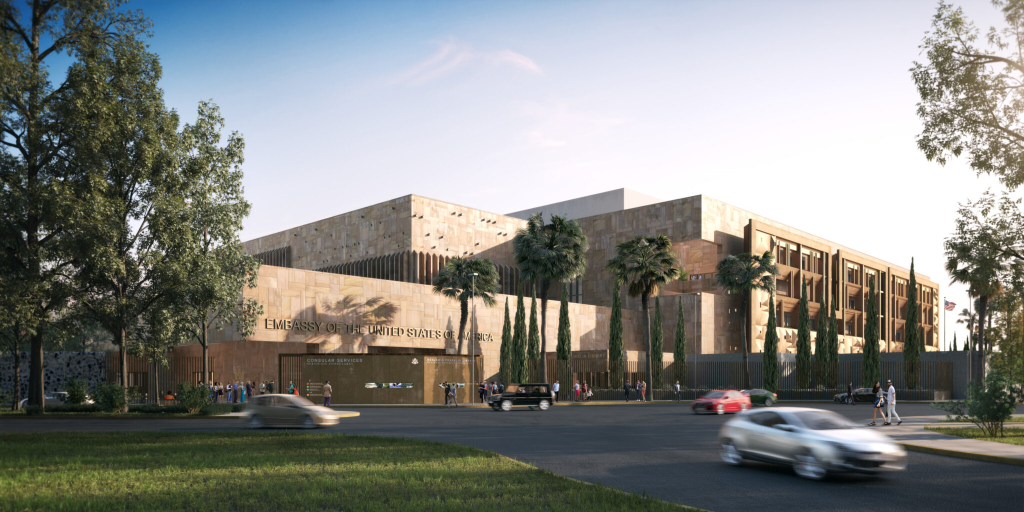
It’s the biggest U.S. embassy in the world. It has seven stories, two of which are under ground level.
Embassy construction is the responsibility of the U.S. Department of State’s Bureau of Overseas Buildings Operations (OBO). The architectural firms are Tod Williams Billie Tsien Architects and Davis Brody Bond Architects. Caddell Construction is the general contractor.
The embassy is located on an 8.5 acre site, formerly the site of a Colgate-Palmolive factory. A toxic cleanup had to be carried out on the site before building.
Construction began in 2018 and it cost over a billion dollars to build.
Here is a proposal illustration generated in the early stages of the project:
Design Illustration, U.S. Embassy, Mexico City. Source” OBO
From the OBO website: “This embassy will consolidate over 530,000 square feet of diplomatic operations, bringing together over 1,400 staff previously spread across multiple sites in the city. OBO embassies and consulates often are the first experience host country citizens and government officials have with the United States overseas and the embassy is designed to streamline the flow of visitors.”
“To ease traffic impact and improve security, the embassy features discrete entrances for various functions. To the north, one entrance accommodates the large number of consular visitors and another welcomes visitors to the Benjamin Franklin Center.”
“The building’s seven floors include two below-grade levels that balance its size without sacrificing usable space.”
“By incorporating the Benjamin Franklin Center on-site, the embassy has a flexible programming space to conduct a broad range of public engagement activities that promote U.S. political and economic goals.”
“An estimated total work force of 2,500 U.S., Mexican and third-country nationals were engaged in the construction of the new embassy.”
Click here for a brief video of Ambassador Johnson entitled “My first day at the historic new U.S. Embassy in Mexico”. The video was released on November 26th, may have been filmed the 24th or 25th or early on the 26th.
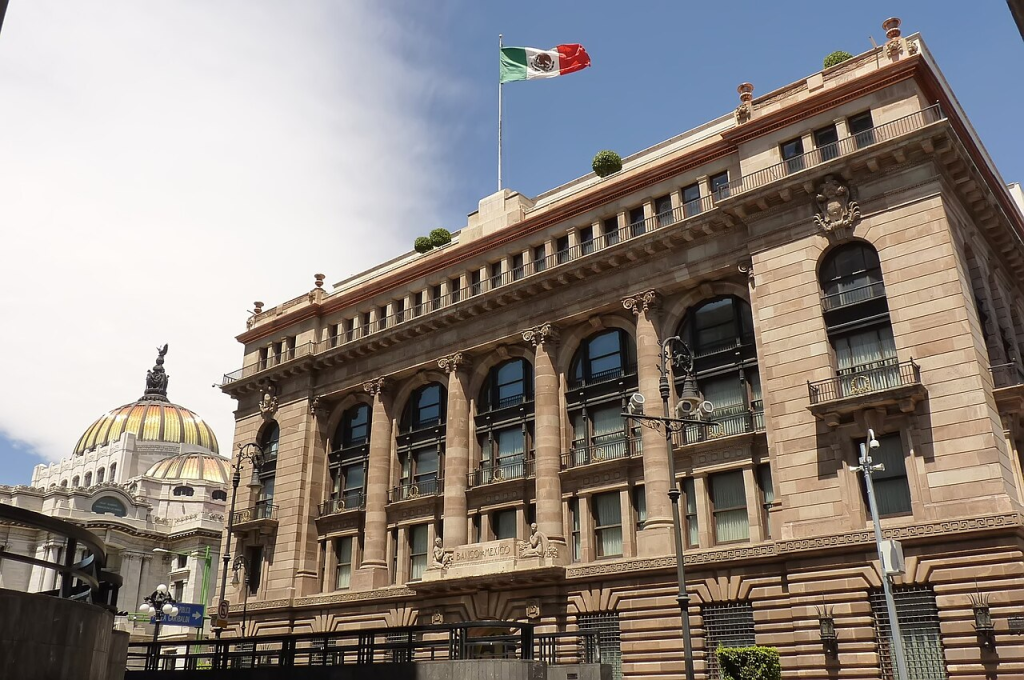
From Wikipedia: “The Banco de México was created on August 25, 1925, under the direction of Minister of Finance Alberto J. Pani with an official ceremony given on September 1, 1925. It was given exclusive authority to mint coins and print banknotes, a sharp departure from policies of the past. The bank was also given responsibility over exchange rates, interest rates, and monetary regulation.”
From the English-language section of the Banco de Mexico website: “Banco de México was inaugurated during a solemn ceremony on September 1, 1925. The act was presided over by President Plutarco Elías Calles and attended by renowned people from the fields of politics, finance and business.”
According to Forbes, the world’s most powerful woman is Ursula von der Leyen, first female President of the European Commission, the executive branch of the European Union.
The second-most powerful woman on the list is Christine Lagarde, first female President of the European Central Bank.
Sanae Takaichi, the first female prime minister of Japan, is #3 on the list. Giorgia Meloni, the first female prime minister of Italy, is #4.
Claudia Sheinbaum is #5 on the Forbes list.
Here’s what Forbes says about her: “Claudia Sheinbaum made history when she was elected Mexico’s first female president in a landslide victory in June 2024. Her swearing-in that October was met with cheers of ‘Presidenta.’ ”
“Born to a Jewish family in Mexico City, Sheinbaum is also the first Jewish president of her country.”
“From 2018 until 2023, Sheinbaum served as Mayor of Mexico City. One of her accomplishments was introducing a new ‘cablebus’ system that improved citywide commuting.”
“An accomplished scientist with a Ph.D. in energy engineering, she is among the scientists and policymakers who share the 2007 Nobel Peace Prize for participation on a United Nations climate science panel.”
Following a proposal of President Claudia Sheinbaum, both houses of the Mexican Congress have voted to put tariffs on China and other countries, mostly China.
From Bloomberg: “Mexican lawmakers gave final approval for new tariffs on Asian imports, broadly aligning with US efforts to tighten trade barriers against China, as President Claudia Sheinbaum seeks to protect local industry.”
“Mexico’s Senate on Wednesday [December 10th] voted in favor of the bill that imposes tariffs of between 5% and 50% on more than 1,400 products from Asian nations that don’t have a trade deal with Mexico. The bill passed with 76 votes in favor, five against and 35 abstentions.”
“The new levies will take effect starting next year and hit a wide range of products from clothing to metals and auto parts, with the massive output of Chinese factories emerging as the legislation’s focus.”
So what does this have to do with Trump’s trade relations with Mexico ?
“Passage of the bill took place against the backdrop of Sheinbaum’s high-stakes trade talks with President Donald Trump and pressure to match his priorities, fueling hopes Mexico’s levies on Chinese goods could ease punishing US tariffs on goods like Mexican steel and aluminum.”
“While Sheinbaum has publicly denied any connection to Trump’s own tariff onslaught against the Asian giant, the new import levies resemble the US leader’s approach.”
According to the Economic Times, “Mexico’s Senate approved on Wednesday tariff hikes of up to 50% next year on imports from China and several other Asian countries, aiming to bolster local industry despite opposition from business groups and affected governments. The proposal, passed earlier by the lower house, will raise or impose new duties of up to 50% from 2026 on certain goods such as autos, auto parts, textiles, clothing, plastics and steel from countries without trade deals with Mexico, including China, India, South Korea, Thailand and Indonesia. The majority of products will see tariffs of up to 35%.”
And, “Analysts and the private sector argue the move is aimed at appeasing the U.S. ahead of the next review of the United States-Mexico-Canada trade agreement (USMCA), and say it is also intended to generate $3.76 billion in additional revenue next year as Mexico seeks to reduce its fiscal deficit.”
The Economic Times quoted Senator Mario Vazquez of the opposition PAN party, “On the one hand, it protects certain local productive sectors that are at a disadvantage with respect to Chinese products. It also protects jobs. But, on the other hand, (…) the tariff is an additional tax that citizens pay when they buy a product. And these are resources that go to the state. We would need to know what they are going to be used for. Hopefully, production chains in the country will be strengthened.”
Until December 5th, Mexican President Claudia Sheinbaum and U.S. President Donald Trump had never met in person, though they had conversed by telephone.
On December 5th, 2025, the two met in person for the first time.
The occasion was the draw for the upcoming World Cup, to be held next year in the U.S., Canada and Mexico.
There are to be 48 national teams competing in the 2026 World Cup. In the first round, they begin by playing within twelve groups of four teams. The purpose of the drawing is to organize those groups of four.
U.S. President Donald Trump, Mexican President Claudia Sheinbaum, and Canadian Prime Minister Mark Carney met at the Kennedy Center in Washington, D.C. for the draw. Trump and Carney had met, and Sheinbaum and Carney had met, but for the first time they were all 3 together, and for the first time Sheinbaum and Trump met in person.
From Reuters: “U.S. President Donald Trump met with the leaders of Mexico and Canada to discuss trade issues on Friday [December 5th] after the leaders hosted the 2026 World Cup draw at Washington’s storied Kennedy Center.”
“The White House said Trump held talks with Canadian Prime Minister Mark Carney and Mexican President Claudia Sheinbaum after the star-studded event, but gave no details on their discussions. Canadian media said the meeting lasted for 45 minutes and the leaders spoke on their own, with no staff present.”
Wouldn’t you have liked to have been a fly on that wall?
And this from the Associated Press: “President Donald Trump has finally met with his Mexican counterpart, Claudia Sheinbaum. Their long-delayed first face-to-face discussion focused on next year’s World Cup — and included side discussions about trade and tariffs — but immigration was not the top issue. That’s despite Trump’s push to crack down on the U.S.-Mexico border being a centerpiece of his administration, and the driving force in the relations between both countries.”
It’s not “despite” Trump’s push to crack down on the border, it’s because of his successful push to crack down on the border. It’s no longer a major issue between the U.S. and Mexico.
Tariffs and drug cartels, well, that’s another story.
Click here for a short video of Claudia’s trip to Washington.
For seven consecutive months, remittances to Mexico have decreased.
Remittances are funds sent by people from Country A working in Country B. It’s sent back to families in Country A. Many countries have grown to depend on remittances.
In the case of remittances going to Mexico, most of those funds are from Mexicans working in the United States.
From Reuters: “Remittances to Mexico declined 1.7% from a year earlier in October, the nation’s central bank said on Monday [December 1st], totaling $5.64 billion.”
“October marked the seventh straight month of year-on-year declines in the remittances the country receives, contrasting with sharp increases reported for Central American countries in 2025.”
So Mexico’s remittances are decreasing but Central American remittances are increasing.
“The total number of remittances in the month declined 5.4%, while the average value of each payment sent edged up 4.0% compared to the same month last year, the central bank added in a report.”
“The amount for October resulted from the accumulation of some 14 million transactions averaging $403 each.”
“Accumulated remittances to Mexico through October 2025 totaled $51.34 billion, 5.1% lower than the amount received during the same period last year.”
A billionaire from outside the formal political system who criticizes the political establishment, runs for president, and wins.
Didn’t that occur in one of Mexico’s neighbors ?
Could it also occur in Mexico?
There are indications that Ricardo Salinas Pliego may run for president in 2030.
Ricardo Salinas Pliego is a billionaire and the third richest man in Mexico (net worth 5.5 billion USD). Salinas is the CEO of Grupo Salinas, a conglomerate which includes the TV Azteca Media Network, Grupo Elektra (incuding Elektra stores and Banco Azteca), soccer teams Club Puebla and Mazatlán Futbol Club, Italika motorcycles, Totalplay telecoms, and others.
Salinas Pliego is the son of Hugo Salinas Price, whose mother was American, see his apellidomaterno. Salinas Price is still alive.
Ricardo Salinas Pliego is a critic of the Sheinbaum Administration. He was against the judicial reform [see here] and supported the recent protests against the administration.
What are some clues that Salinas Pliego might run for president?
Well, one is that he recently updated his Twitter X profile. You can see it here. It now has a Mexican flag in the top photo. The photo is blurry, but maybe that symbolizes something too.
And Salinas Pliego has this statement near the top: “The State is not the solution, it is the problem. Do not let yourselves be intimidated by the parasites of the State, the only thing they want is to perpetuate themselves in power.” (automatic translation from site)
That’s small-government ideology, quite different from that of President Claudia Sheinbaum and the MORENA party.
Another evidence that Salinas Pliego might run is that he is reported to be thinking about selling his two soccer teams, Club Puebla and Mazatlán Futbol Club, in order to finance a campaign. That could net him $165 million. [See Salinas Pliego will sell Mazatlán and Puebla on the Mexico Daily Post.]
Then there’s this story, also reported on Mexico Daily Post. Salinas Pliego traveled to El Salvador in Central America, where he met with that nation’s President Nayib Bukele, who drastically reduced the murder rate by putting lots of criminals in jail.
From Mexico Daily Post: “The businessman [Salinas Pliego] shared that during their meeting, they discussed issues related to public safety and the administration of justice, areas that, he affirmed, should be a priority in Mexico. He added that if he were to lead the Mexican government, he would adopt a strategy similar to Bukele’s.”
And, quoth Salinas Pliego, “ ‘While talking with President Bukele, I told him that if I were President of Mexico, my government’s number one priority would be the same as his: to declare war on criminals and use the full force of the State to immediately restore order in the country, with the goal of giving Mexican families a life of peace.’ ”
If Salinas Pliego did run, what party would he run for?
Mexico was already the largest exporter to the United States. Now it’s the largest importer from the United States.
From Mexico News Daily: “In 2023, Mexico became the world’s top exporter of goods to the United States, surpassing China. Now it also the top buyer of U.S. goods, outpacing Canada, according to U.S. government data published on Wednesday [November 19th].”






.jpg)

