In the Middle East, Israel and Iran have been bombing each other and more recently the U.S. has bombed Iran.
The SRE (Secretaría de Relaciones Exteriores), Mexico’s foreign ministry, has continued to evacuate Mexicans from the Middle East. (See this previous article on the topic).
As of June 22nd, 2025, the SRE reported that it had evacuated 175 Mexicans.
As a service to my readers, here below is a world map, showing all the countries mentioned in the article in red:
“MEXICAN EMBASSIES IN THE MIDDLE EAST CONTINUE ON ALERT, OFFERING ASSISTANCE TO FELLOW MEXICANS IN THE REGION”
“The SRE personnel, through their embassies in Iran, Israel, Jordan, Egypt and Azerbaijan, remain on alert and continue offering orientation, assistance and consular protection to the female and male Mexicans found in the Midde East, particularly to faciliate their departure from the zone of conflict. To this point, they have facilitated the evacuation of 175 persons who have departed safely and are doing well.”
ISRAEL: “Israeli airspace is only partially open. The [Mexican] embassy in Israel has facilitated the departure by land and sea to Egypt, Jordan and Cyprus, of 116 Mexican persons.”
JORDAN : “The embassy in Jordan has supported the departure of 29. The [Jordanian] airspace is open, but the flights continue being irregular with frequent cancellations.”
IRAN: “The [Mexican] embassy in Iran assisted a second group of fellow Mexicans who departed successfully to Azerbaijan, where they were received by the personnel of our embassy in that country. In total 30 persons have departed from Iran, all of them are safe and well.”
On the early morning of June 15th, 2025, residents of northeast Mexico and the adjacent Texas border region were treated with a brief but spectacular sight – a fireball (a very bright meteor) which streaked across the night sky.
On its website, the American Meteor Society has a very detailed page on the phenomenon, click here to see it.
The Society received 20 reports of the fireball, which are portrayed on that detailed page. After its brief flyby, there were reports of a boom which may have been the meteor’s explosion.
The majority of the sightings were in the Monterrey-Saltillo area of Nuevo Leon and Coahuila states, with a couple of others in Nuevo Laredo and Ciudad Victoria, Tamaulipas.
The U.S. sightings were along the Texas side of the border.
One group that got a first row seat was a group of campers at the Potrero Chico Park near Hidalgo, Nuevo Leon. This park is a famous destination for rock climbers and is considered one of the top ten sport climbing locations in the world.
The campers, members of the Sociedad Astronómica de Nuevo León (Astronomical Society of Nuevo León), were there for astronomical observation and were thus not disappointed.
The organization posted this on Facebook [translated to English]: “This weekend, we went camping… with 100 people to live an astronomical experience under the stars, and what do you think?????? Yes, we saw the fireball that came in at 2 a.m.”
For detailed information on the sightings and a couple of videos, click here.
On June 10th, DHS Secretary Kristi Noem said that“Claudia Sheinbaum came out and encouraged more protests in LA, and I condemn her for that. She should not be encouraging violent protests that are going on.”
This was rapidly denied by President Sheinbaum. Sheinbaum has also denounced the violence and even criticized the use of the Mexican flag in the riots.
Possibly Secretary Noem based her accusation on Sheinbaum’s June 8th comments (reported here on Mexico News Report) in which Sheinbaum said she didn’t agree with the ICE raids and supported Mexican immigrants in the United States.
These are standard talking points that any Mexican president would use, but they don’t really constitute encouraging violent protests.
Mexican Senator Lilly Tellez accused President Sheinbaum of calling for the demonstrations, which she said were carried out by MORENA party members in the United States.
On the internet, the main proof for this accusation was a very brief (13-second) video in which Claudia Sheinbaum made this forceful declaration: “… because if necessary we are going to mobilize because we don’t want taxes on the remittances of our fellow Mexicans to Mexico.”
What’s she talking about?
The problem with short videos is they don’t provide much context.
I wanted to see the context, so I located the source of the video. It was part of a discourse Sheinbaum delivered in the state of San Luis Potosi on May 24th.
Click here for a video of the whole discourse, the relevant part begins after 47 minutes. And here is the transcript.
In this discourse, Sheinbaum spoke about the proposal in the U.S. Congress to tax remittances. Of course President Sheinbaum is against that proposal. Any Mexican president would be. She was complaining about it when she made her mobilization comment.
All of us, regardless of our views, should be careful how we handle our sources.
I see no solid evidence that President Sheinbaum incited the riots in Los Angeles. Besides, it doesn’t fit her standard operating procedure nor that of Mexican presidents in general.
Does that mean the Mexican government doesn’t meddle in U.S. politics?
No, I wouldn’t say that either.
The Mexican government does meddle in U.S. politics, but in a different manner. Not by calling for riots, but by claiming sovereignty over U.S. citizens of Mexican ancestry.
The Mexican government has been doing this for years but nobody in the U.S. government, of either party, seems to give a hoot about it.
In the 2016 election the Mexican diplomatic corps had a program to help Mexicans in the United States rapidly nationalize as U.S. citizens. Why? So they could vote against Donald Trump !
There was nary a peep against this from anybody in authority nor even from the Trump campaign.
In the 1990s, Mexico changed its nationality law to allow dual citizenship, specifically so Mexicans could vote in U.S. elections in the interests of Mexico.
That’s the real story, ignored in favor of a 13-second video ripped out of context.
In Sheinbaum’s San Luis Potosi discourse, she did not call for riots on U.S. soil. But she did talk about using dual citizens to meddle in U.S. politics, arguably more injurious to U.S. sovereignty than inciting riots.
Here’s what she said: “We called on our paisanos [fellow Mexicans] that are there, many of them have double nationality… to send emails on their social networks to [U.S.] senators to tell them that we do not agree with that [taxes on remittances]…”
If you know that you can make sense of the 13-second segment: “… because if necessary we are going to mobilize because we don’t want taxes on the remittances of our fellow Mexicans to Mexico.”
President Sheinbaum wasn’t calling for riots but for dual citizens to contact their U.S. senators to influence them to vote against taxes on remittances.
That very brief video circulating not only gave viewers the wrong impression but failed to show the real meddling President Sheinbaum was actually calling for !
But there’s more: “We [Mexicans] are almost 40 million over there among the first, second and third generations, that is, grandparents who went to live there and that had their children and their grandchildren and they all want to have double nationality and now they have been nationalized in the United States for a long time, many of them that are there.”
When President Sheinbaum talks about “40 million Mexicans” in the United States she is including American citizens and even American citizens who were born in the U.S. and have never visited Mexico.
Sheinbaum is not unique in this viewpoint. That’s the common view in Mexico, that Americans citizens of Mexican ancestry are essentially Mexican, regardless of citizenship.
Could that be a threat to U.S. citizenship and sovereignty?
U.S. politicians don’t care about it. But maybe American citizens ought to at least be aware of it.
It illustrates a real disconnect between how immigration and citizenship are viewed in Mexico and in the United States.
That’s a bigger potential problem than the riots but it wasn’t included in that 13-second video.
Here at Mexico News Report the goal is to provide accurate, documented information on Mexico, in context. Click here if you would like to donate to the work.
The SRE (Mexican Foreign Ministry) has evacuated a group of 18 Mexicans from Iran to nearby Azerbaijan. There is a Mexican embassy in each of those countries which enabled them to carry out the evacuation, which occurred on June 18th, 2025. The bombing war between Israel and Iran is the reason for their evacuation.
Here is a map of the relevant countries: Mexico, Israel, Azerbaijan and Iran. Azerbaijan is north of Iran on the landlocked Caspian Sea:
Also on the 17th, the SRE released a tweet on Twitter/X which said “…the Mexican embassy in Israel maintains permanent communication with the Mexican community and continues providing information about possible departure options from the country to those persons who have requested, always putting their safety first. Additionally…assistance and coordination with other Mexican embassies in the region, Jordan and Egypt, continues, to verify the operational availability of overland departures from Israel. Commercial flights remain closed. The SRE will continue offering consular protection to fellow Mexicans in the Middle East at all times.”
And just to cover all the bases, the SRE tweeted this message on the 17th:
This message says that the SRE continues offering assistance to Mexicans already in the Middle East but says Mexicans shouldn’t travel there now. It contains the phone numbers of Mexican embassies in Iran, Lebanon, Egypt, Qatar, Israel, the United Arab Emirates, Saudi Arabia and Jordan.
From the New York Times article: “Party loyalists control a new tribunal with the power to fire judges and the court that decides federal election disputes.”
“Leaders of the Morena party, which already holds the presidency and Congress, had insisted that their contentious judicial overhaul…would not be a power grab. On the contrary, they said, it would make judges accountable to voters and begin to fix a system that most Mexicans say is marred by corruption, nepotism and widespread impunity for criminals.“
“But Mexico’s shift away from an appointment-based system to having voters elect judges has, at least for now, amounted to a crucial step in Morena’s consolidation of power, according to final election results made available on Sunday [June 15th].”
“Candidates with Morena’s stamp of approval sailed to victories in Mexico’s most powerful courts and in court circuits across the country, showcasing critics’ fears that the election could eliminate the last major check on Morena’s power.”
The article quotes a current judge who is a critic.
“ ‘You now have an administration that controls the presidency, that controls the Congress with supermajorities in both chambers and that now controls the judges,’ said María Emilia Molina, a circuit magistrate and president of the Mexican Association of Women Judges…Judge Molina, 53, said she planned to resign sometime this year.”
And, says the article, “Many questions remain about how the system will change in practice, especially since the overhaul did not address elements that many Mexicans criticize as corrupt or unresponsive, like prosecutors and the police.“
Nobody would deny that Mexico has serious problems in its legal system. But is this new system the answer?
Then there is the court called the Tribunal de Disciplina Judicial, the Tribunal for Judicial Discipline.
“Another untested factor is the new Tribunal for Judicial Discipline, which has broad powers to investigate and even impeach some judges — powers that critics say could be used to remove uncooperative judges.”
It’s the classic question Quis custodiet ipsos custodes? Who will guard the guards themselves?
The reform was rammed through Congress by President Andres Manuel Lopez Obrador before he left office on October 1st, 2024.
“As president last year, Andrés Manuel López Obrador marshaled support for electing judges after courts tried to block some of his major projects and plans.”
“Timing and Morena’s current unrivaled popularity were also pivotal factors. Cementing the party’s dominance, Claudia Sheinbaum won last year’s presidential election in a landslide as party allies unexpectedly won the majorities needed in Congress to change Mexico’s Constitution.”
The turnout on June 1st was very low.
“But while polling showed support for the overhaul, nearly 90 percent of voters abstained from casting ballots this month… The dismal turnout, only 13 percent of 100 million voters, fueled concerns over the election’s legitimacy, especially as it became clear that many voters also invalidated their ballots or left them blank.”
“Factors that contributed to the low turnout included dizzying number of options on the ballots, a limited budget to organize the election, and relatively little understanding of what judges do, said Ernesto Guerra, a political analyst. ‘Evidently, people were not interested in this process,’ Mr. Guerra said.”
Then there’s this…
“The voting also provided a glimpse into potential fissures emerging within Morena. In numerous states, voters veered from Morena’s guidance to select candidates who were less inclined to align explicitly with the governing party — even if these candidates were also not aligned with the opposition. ‘Those fractures could widen as time goes by,’ Úrsula Indacochea, a judicial expert at the Washington-based Due Process of Law Foundation, said.”
“ ‘That’s the proof that the judicial election was a bad idea, even for those who proposed it,’ she said. ‘By politicizing justice, judges act like politicians — and politicians switch sides.’ “
President Claudia Sheinbaum is still gung-ho for the reform.
“President Sheinbaum recently seemed to acknowledge some criticism, especially regarding turnout. ‘We need to see what can be refined to make it easier for Mexican men and women to vote,’ she said. But, she added, ‘I’m convinced that this election will clean up the judiciary.’ “
And the opposition?
“The opposition, which seems to be on life support in much of the country, will not have a chance to challenge Morena’s dominance in the courts until 2027, when voting will take place in the judicial elections’ second phase.”
“ ‘There won’t be any institutional check on Morena’s power for at least the next two years,’ Juan José Garza Onofre, a constitutional law researcher at the National Autonomous University of Mexico, said.”
“By then, Mexicans will also have had a chance to reshape other parts of the government, too, casting ballots for 17 new governors, 500 seats in the lower house of Congress, hundreds of mayors and over 1,000 local legislators.”
Click here for results of the June 1st election on the INE (Instituto Nacional Electoral) website.
Mexico is moving into uncharted territory, so we have to watch to see how things develop. But it certainly looks like an expansion of the power of the MORENA party.
On June 15th, 2025, NASCAR held a Cup Series Race (its highest level), for points, in Mexico City. It was the first such race in Mexico and the first outside the U.S. since 1958. (See here and here).
On June 14th, the day before the Cup Series Race an Xfinity race (NASCAR’s second level) was held. The winner was NASCAR racer Daniel Suarez, of Monterrey, Mexico.
NASCAR races are preceded by an invocation and the singing of “The Star-Spangled Banner”. This race was preceded with an invocation by a Catholic priest and the singing of both “The Star-Spangled Banner” and the Mexican national anthem “Mexicanos al Grito de Guerra” by a girls’ chorus.
In second place was Christopher Bell of Oklahoma. In third place was Chase Elliott, in fourth place was Alex Bowman, and in fifth place Michael McDowell.
Daniel Suarez, who had won the Xfinity race the previous day, placed 19th in the Cup Series race on the 15th.
Here’s a photo of Daniel Suarez’s racing helmet in Mexico City:
The Autódromo Hermanos Rodríguez is a race track in Mexico City. It’s the scheduled site of NASCAR’s first Cup Series Race for points in Mexico, to be held June 15th, 2025. (See here and here). It’s the first such race to be held in Mexico and the first to be held outside the U.S. since 1958.
The second-level Xfinity race is scheduled for June 14th.
The Autódromo Hermanos Rodríguez racetrack is owned by the city of Mexico City, but operated under concession by OCESA, a subsidiary of the Corporación Interamericana de Entretenimiento (CIE).
The autodromo was first constructed in 1959, as part of the Ciudad Deportiva Magdalena Mixhuca, a sports complex in Mexico City.
The track was originally called the Autódromo Magdalena Mixhuca. It was later named after the Rodriguez Brothers, Ricardo and Pedro, Mexican race car drivers who both died racing.
The racetrack’s circuit was designed in the 1950s by Oscar Fernandez Gomez Daza, a UNAM student. The design was part of his thesis about why Mexico City needed a racetrack. Amazingly, when they actually did build a track, his design was used for it.
And who was in charge of this project’s construction? None other than Pedro Rodriguez, father of the racing brothers Pedro and Ricardo, for whom the track was later named.
The first race at the Autodromo was in December of 1959, and it was won by Pedro Rodriguez Jr., with brother Ricardo placing 3rd.
Tragically, Ricardo was killed in a crash, at the age of 20, in a practice for the Mexican Grand Prix in Mexico City at the same autodromo and Pedro was killed in a race in West Germany in 1971.
So in 1979 the track was renamed the Autódromo Hermanos Rodríguez in honor of the two brothers.
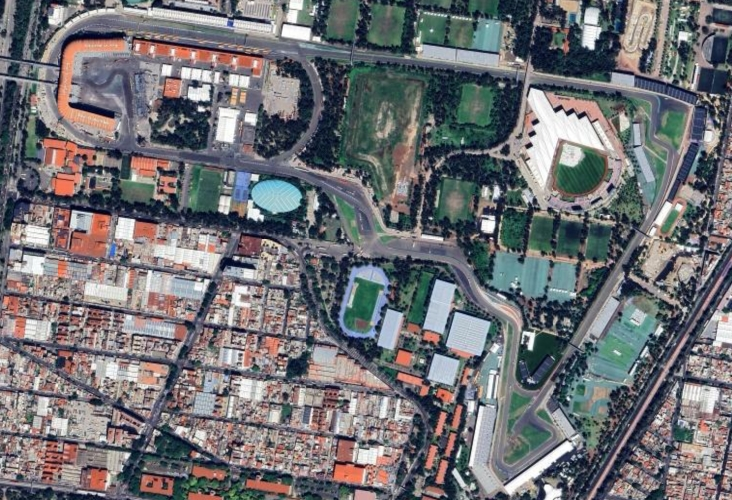
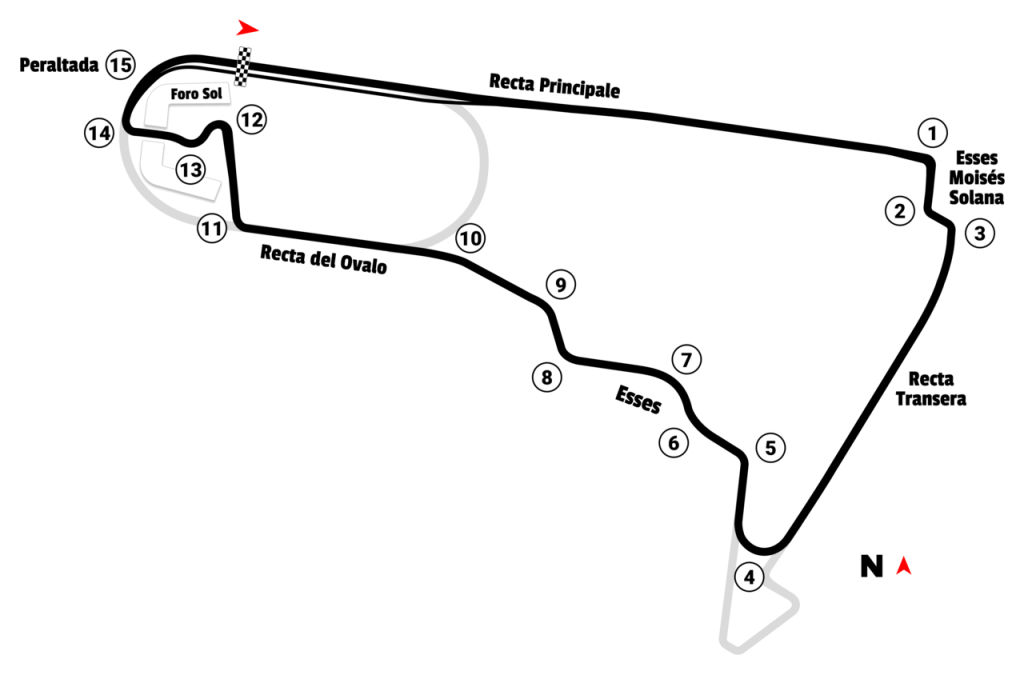
The Autódromo Hermanos Rodríguez sits at an elevation of 7,343 feet and the thin air can be a problem for drivers and cars. This also reduces the aerodynamic drag on the race cars. It can seat 110,000 spectators. Here is an aerial photo of the track:
The Mayan site of Chichen Itza is one of Mexico’s most famous archaeological tourist destinations. I’ve been there a couple of times, it’s a fascinating site.
On June 11th, 2025, Chichen Itza was taken over by protesting teachers.
From Mexico News Daily: “Hundreds of teachers from the National Coordination of Education Workers (CNTE) have escalated their protest movement in Yucatán this week, taking over the Chichén Itzá archaeological site on Wednesday [June 11th] and staging a demonstration at the Maya Train station in Valladolid on Thursday [June 12th].”
“The actions are part of a continuing wave of mobilizations —including a 23-day sit-in at Mexico City’s Zócalo that ended this week— demanding sweeping changes to Mexico’s education and pension systems.”
So what occurred exactly?
“On Wednesday morning [June 11th], around 300 CNTE members occupied the ticket booth at Chichén Itzá, allowing free entry to tourists and setting up tents at the site, all the while chanting slogans in Spanish…Similar actions took place at Ek Balam and Uxmal, with teachers reiterating their demands for a 100% salary increase, 90 days of bonuses and, mainly, the repeal of a 2007 ISSSTE (public sector social security) law that restructured federal pensions.”
“They even issued a statement in English, explaining their demands and the reasons for their protests, in the presence of foreign tourists and the media.”
Interesting that they would appeal to foreign tourists. But couldn’t that potentially lead to foreigners taking sides in a Mexican labor dispute?
“Despite the disruption, authorities from the National Institute of Anthropology and History (INAH) and local police did not intervene, and operations for tourists continued under the supervision of site staff.”
So tourists weren’t impeded from visiting the site and even visted Chichen Itza for free.
Here’s a photo of the striking teachers posing in front of the El Castillo pyramid, Chichen Itza’s star attraction:
Protesting CNTE teachers pose in front of El Castillo, Chichen Itza. Source: Mexico News Daily
Will this new court maintain judicial independence?
Who are the nine newly-elected justices of the Supreme Court?
The Chief Justice, or as they say in Spanish, Presidente de la Corte, is to be Hugo Aguilar Ortiz, who was the biggest vote-getter on the Supreme Court ballot, receiving over 6 million votes (6,195,000).
Hugo Aguilar Ortiz, Mexico’s Chief Justice-Elect. Source: Excelsior
Aguilar, 51, is a lawyer and Mixtec Indian from the state of Oaxaca. Currently, he serves as indigenous rights coordinator of INPI, the Instituto Nacional de los Pueblos Indígenas ( National Institute of Indigenous Peoples). Aguilar has never served as a judge before.
Here is a list, in descending order of their votes, of the 9 newly-elected judges of the Mexican Supreme Court.
Hugo Aguilar Ortiz, currently an official of INPI. Received 6,195,000 votes.
Lenia Batres Guadarrama, Already on the Supreme Court, 5,802,000 votes.
Yasmin Esquivel Mossa, already on the Supreme Court, 5,000,310 votes.
Loreta Ortiz Ahlf, already on the Supreme Court, 5,012,000 votes.
Maria Estela Rios Gonzalez, former legal advisor to AMLO, 4,729,000 votes.
Giovanni Azael Figueroa Mejia, lawyer with constitutional law doctorate, 3,655,000 votes.
Irving Espinosa Betanzo, lawyer/Mexico City anti-corruption magistrate, 3,587,000 votes.
Aristides Rodrigo Guerrero Garcia, lawyer and former Mexico City official, 3,584,000 votes.
Sara Irene Herrerias Guerra, Head of human rights department of Attorney General, 3,268,000 votes.
It’s important to note that before the election, the MORENA party, which is the party of President Sheinbaum and the party that runs Congress, distributed papers to voters which listed judges on the ballot recommended by MORENA.
All nine winning judges, slated to serve on the new Supreme Court, were MORENA-approved, meaning it’s less likely that they are going to exhibit much judicial independence.
In fact, three of the judges (Batriz, Esquivel, Ortiz) were already on the Supreme Court, having been appointed to the Court by previous MORENA president AMLO. Another judge, Maria Estela Rios Gonzalez, is a former legal advisor to AMLO.
And, once again, the nine Supreme Court winners were all on the MORENA recommendation sheets.
AMLO, moreover, did not like the Supreme Court ruling against him, and it is AMLO who engineered the judicial reform before he left the presidency on October 1st, 2024, to be replaced by Claudia Sheinbaum.
You can see the concern that this judicial election could be a way for MORENA to get control of the judicial branch.








.png)
#/media/File:Morena_logo_(Mexico)_(positive).svg)