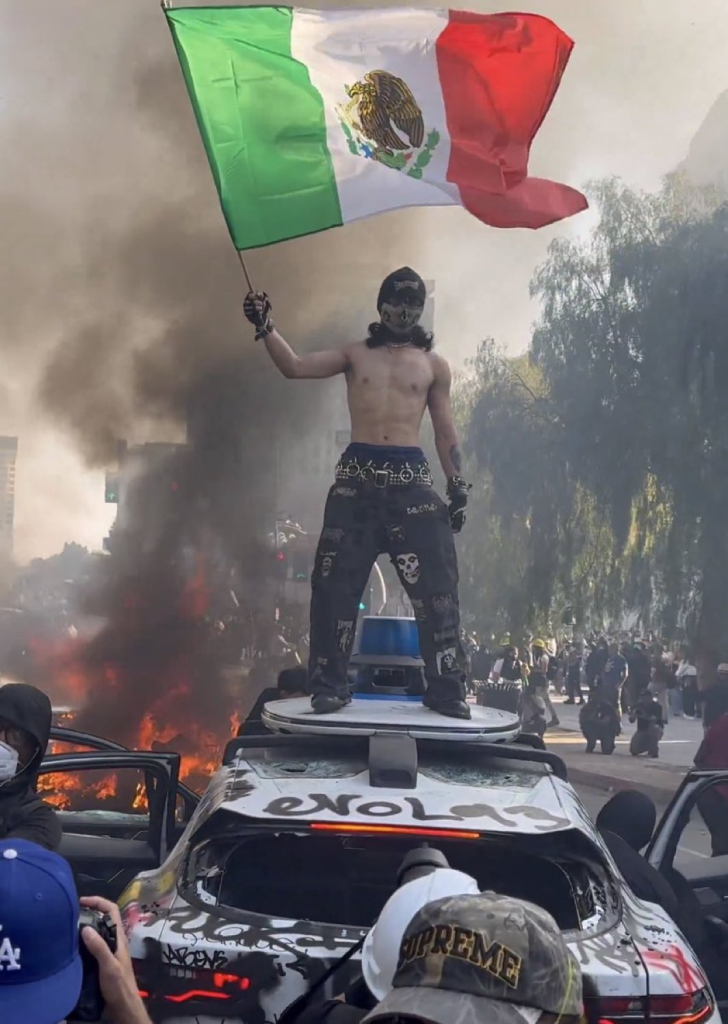
Those who oppose the immigration policies of President Trump may actually be helping him. Violence against immigration enforcement and the brandishing of the Mexican flag in a protest on U.S. soil can strengthen Trump’s case and bring more of the public over to his side.
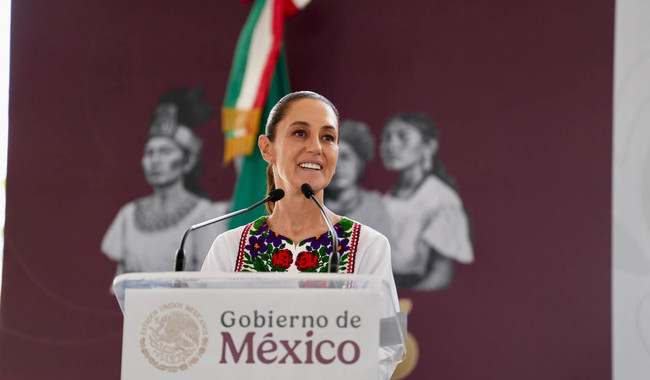
On June 8th, Mexican President Claudia Sheinbaum responded to the LA events, as part of a speech she was delivering in San Andres Cholula, Puebla.
Click here for the entire public presentation of which the speech was a part, the LA segment begins at about the 43 minute mark.
Here’s a photo of President Sheinbaum at Puebla, although she wasn’t smiling when she was talking about LA:
Sheinbaum’s approach was to spend a lot of time defending Mexicans in the United States without getting into how some of them got into the country illegally and how these protests are hurting her case.
Some excerpts: “The male and female Mexicans [sounds awkward in Spanish also] who live in the United States are good men and women, honest people, who went to the United States to seek a better life for themselves and contribute to their families. They are not criminals, they are good men and women, honest, they all have the solidarity of their government.”
These are typical talking points used by any recent Mexican president. She doesn’t mention however that the Mexicans being detained and deported from the U.S. are people who entered the country illegally or overstayed visas thus becoming illegal aliens.
Since she was in Puebla she brought up all the poblanos (Puebla people) in New York City: “…there are so many poblanos and poblanas (male and female natives of Puebla) that they call it ‘Puebla York’ because New York would not be what it is if not for the poblanos there.”
She then applied the same logic to LA.
“Los Angeles would not be what it is if not for the male Mexicans and female Mexicans that are there.”
The problem with that line is you could interpret it two ways !
And of course, she said that “The United States is what it is thanks also to the work of the female Mexicans and male Mexicans who live on the other side of the border.”
President Sheinbaum expressed her disagreement with the how the U.S. is enforcing its immigration law. “We do not agree with the way of dealing with this migratory phenomenon, it is not with raids and with violence that you attend to the migratory phenomenon. It is sitting down, working on a comprehensive migratory reform that takes into account all the Mexicans who are on the other side of the border. That is our position. And always a call for peace, not violence, and not exacerbating any form of violent demonstration.”
Bottom line: The Mexican government doesn’t want the U.S. to enforce immigration law against Mexicans. So what else is new?
On the other hand, Sheinbaum understands that a new sheriff is in town north of the border and she has been cooperating, by accepting Mexican deportees.
Sheinbaum’s comments were not surprising and any Mexican president would say something similar. Such comments are designed for the Mexican public.
However, the American public is not likely to be convinced by her comments, and it’s in the U.S.A. that these events are occurring.
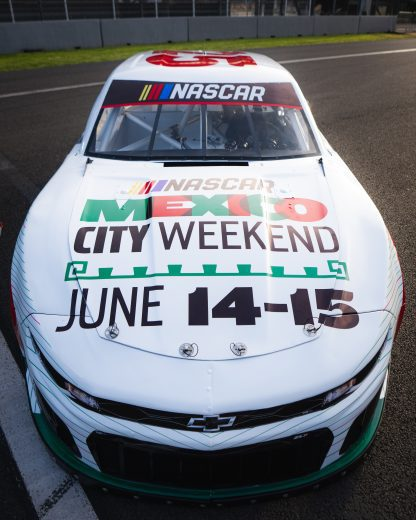
The trick is, there’s a NASCAR Cup Series race a week previous, on June 8th, in Michigan at the Michigan International Speedway.
So what does NASCAR have to do to move all its cars, personnel and equipment to Mexico City?
From Pro Football & Sports Network: “Organizing a race is more challenging than most people imagine. There are hundreds of moving parts behind the scenes, and it can be taxing. This becomes all the more difficult if the competition is outside the national border. As NASCAR heads to Mexico City for its first international points race since 1958, it is undoubtedly an exciting time for the sport. But with all the excitement and curiosity, the contest also presents some challenges and constraints, primarily logistical. Tom Bryant, the VP of Racing Operations at NASCAR, recently addressed this issue and explained what the team has been doing to tackle it.”
Back to the article: “After the upcoming weekend at Michigan International Speedway, NASCAR will move in a completely different direction, landing at Autódromo Hermanos Rodríguez in Mexico City.“ Here’s an aerial photo of the Hermanos Rodriguez track from 2024:
“While the race’s planning began a year ago, NASCAR has already started the execution phase. Several race logistics trucks arrived in Mexico earlier this week.“
The next lot of trucks is set to begin their journey on Sunday, June 8, right after the FireKeepers Casino 400 in Michigan.
Bryant mentioned the biggest challenge was the time and the distance between the two locations. A trip from Michigan to Mexico City takes about 40 hours by road, plus the safety of the logistics in the trucks has to be a priority.
“We’ve got to get these people and these things from this point to that point within a certain time period. How do we do it in a way that’s going to best position us to be ready to go to work as soon as we hit the ground down there? Because this is a pretty tight window,” Bryant said.
The XFinity (NASCAR’s second level) race is scheduled for June 14th.
“NASCAR and the teams will have a busy weekend. The Xfinity Series cars will begin their Mexican escapade from North Carolina on Saturday, June 7. They will arrive in Laredo, Texas, on Sunday morning, from where Bryant will assist in overseeing and coordinating the border crossing of Xfinity Series teams.”
The Cup Series is NASCAR’s highest level.
“For the Cup cars, the teams will swap vehicles and begin preparations during the contest itself, departing as soon as the checkered flag is raised. The teams are scheduled to arrive in Mexico City on Tuesday, June 10, and finally enter the track on Thursday, June 12.”
“Bryant, once again emphasizing the extremely tight window, also added, ‘It better happen on time.’ “
“While Bryant himself has a logistics background, pulling off such a big event by himself would be quite a stretch. To ensure smooth functioning on the backend, NASCAR has partnered with Rock-It Cargo.”
“The company also handles the infamous Formula One haulers, moving them internationally, and bagged the contract for the upcoming World Cup.”
“ ‘We’re anticipating no issues. Those guys [Rock-It Cargo] have been doing it for 45 years and haven’t had an issue, so knock on wood, we’re gonna keep that record going for them,’ Bryant said.“
“The current plan, although solid, works if things go according to schedule.”
As a result of Mexico’s judicial election held on June 1st, the new slate of judges for the Supreme Court (Suprema Corte de Justicia de la Nación) has been chosen.
The new Supreme Court is set to take office on September 1st, with nine justices (as in the United States).
The Supreme Court ballot had 64 candidates, arranged in four columns. Here’s a picture of it (the Supreme Court ballot on top):
Judicial Election Ballots, Supreme Court ballot on top. Source: Diegoromch
The left two columns listed 33 female candidates and the right two columns listed 31 male candidates. The voters were asked to vote for four male candidates and five female candidates. The top 9 vote-getters are the new justices.
The top vote-getter, Mexico’s next Presidente de la Corte (Chief Justice) is Hugo Aguilar Ortiz, who received over 6 million votes (6,195,000).
Aguilar, 51, is from the state of Oaxaca and is a Mixtec Indian. Currently, he serves as indigenous rights coordinator of INPI, the Instituto Nacional de los Pueblos Indígenas ( National Institute of Indigenous Peoples).
Last September a war broke out between two factions of the Sinaloa Cartel.
The intra-cartel war pits one faction, La Mayiza, led by the son of “El Mayo” Zambada, against the Chapitos, sons of “El Chapo” Guzman.
According to the Noroeste newspaper, the murder toll in Sinaloa from September 9th, 2024, to June 2nd, 2025, was 1,401, which would average out to 5.3 daily.
According to a recent English-language report from Spain’s El País, the Chapitos faction is on its way out. Besides the pressure from the El Mayo faction, the Chapitos are under pressure from both the Mexican government and the U.S. government. The U.S. government has been using a carrot and stick approach to reduce the cartel. And Trump’s tariff pressure on Mexico gives the Sheinbaum administration a powerful incentive to produce public arrests and drug busts.
From El País: “Los Chapitos have become an endangered species. Only a few of their top bosses — the very ones immortalized in corridos for a few pesos or whose initials adorn caps sold on the streets of Culiacán — are still standing. Imprisoned, killed, extradited to the U.S., or voluntarily surrendered to U.S. authorities as part of plea deals to reduce sentences, the Sinaloa Cartel faction is rapidly vanishing. Only two leaders — Iván Archivaldo Guzmán and his brother Jesús Alfredo — remain at large. But they are increasingly cornered by Mexico’s security forces, who take daily pride in announcing new arrests and deaths of the traffickers whom Washington has identified as key figures behind the fentanyl crisis.“
OK, so the Chapitos faction is going downhill. But nature abhors a vacuum. Will the decline of this faction and its desperate alliance with the CJNG make that cartel more powerful?
Mexico is moving into some unexplored territory, both for itself and for the world.
On June 1st, 2025, Mexico held its first-ever judicial elections. The country is adopting a system in which all judges, at all levels, are elected. No other country does this. Think of it as an experiment. Now the world can see how it turns out.
Late in the day on June 1st, President Sheinbaum was upbeat about the election, declaring that “The historic judicial election of June 1, 2025, has been a complete success.”
Sheinbaum described the election thusly: “Close to 13 million Mexicans went out to exercise for the first time in history their right to decide who should be the new ministers, magistrates and judges.”
This reform has been widely criticized and opposition parties called for a boycott. Election boycotts are called for when the election is seen to be illegitimate. The problem though for those who call for a boycott is they are ceding their own voice in the process.
The ballots were complicated. There were six of them.
Here is a photo of some of the ballots. The Supreme Court ballot is on top. The left two columns list 33 female candidates and the right two columns list 31 male candidates. The voter is asked to vote for four male candidates and five female candidates. Mexico’s new Supreme Court is to have 9 justices.
Turnout was low, with about 13 million turning out to vote. Since the Mexican electorate is just shy of 100 million, that means 13% of the electorate showed up.
Contrast that to the 60% who voted in last year’s presidential election.
It’s probably a combination of lack of interest, the newness and complication of the process, the boycott calls, and the fact that, just as in the U.S., it’s harder to get voters to turn out for non-presidential elections.
AMLO himself, the architect of the reform, has kept a low profile since leaving office October 1st, 2024. AMLO showed up to vote at his voting station in Chiapas. Upon his arrival, the former president declared that “We have the best president in the world.” AMLO also said that “It gives me great joy to live in a free and democratic country.”
The U.S. Drug Enforcement Administration (D.E.A.) has released its 2025 National Drug Threat Assessment, and it paints a grim picture of the Mexican cartel threat. You can see the document yourself here.
Mexican drug cartels are referred to as Transnational Criminal Organizations (TCOs).
Here’s what the threat assessment says about these TCOs: “Mexican TCOs are among the world’s leading producers of illicit drugs, such as fentanyl, methamphetamine, and heroin; they also control the wholesale trafficking of these drugs, and others such as cocaine, into the United States. These TCOs form business relationships with U.S. drug trafficking organizations and violent criminal organizations for the distribution and retail sale of drugs, which drives addiction, overdose deaths, and violence in communities nationwide. Beyond fueling the drug overdose crisis in the United States, TCOs engage in extreme violence, including murder and intimidation, and hostile takeovers of territory and trafficking routes in Mexico and throughout Latin America. Six powerful Mexican TCOs were designated as foreign terrorist organizations by the Department of State: the Sinaloa Cartel, the Jalisco New Generation Cartel, the Gulf Cartel, the Northeast Cartel, the New Michoacán Family, and the United Cartels.”
The document then proceeds to provide information about individual TCOs. The biggest two are the Sinaloa Cartel and the CJNG.
THE SINALOA CARTEL
Here’s how the document describes the Sinaloa Cartel: “The Sinaloa Cartel (Cártel de Sinaloa, aka CDS) is one of the world’s most powerful drug cartels and one of the largest producers and traffickers of fentanyl and other illicit drugs to the United States… For decades, CDS has smuggled multi-kilogram quantities of illicit fentanyl, methamphetamine, cocaine, heroin, and marijuana into the United States and around the globe.”
According to the D.E.A., the Sinaloa Cartel operates in at least 40 countries in the world. Here is a map of the cartel’s dominant areas of operation in Mexico:
Regarding fentanyl: “CDS controls and operates extensive, multi-faceted, transnational networks to facilitate the procurement and shipment of precursor chemicals from China and India to synthesize deadly synthetic drugs, including fentanyl, in Mexico-based clandestine laboratories.”
Regarding methamphetamine: “CDS produces multi-ton quantities of exceptionally high-purity and -potency methamphetamine in clandestine laboratories. According to DEA’s Special Testing and Research Laboratory, methamphetamine seized and tested has reached the highest purity and potency ever recorded, with average purity levels reaching nearly 97 percent in 2025. The ample supply, low cost, and high potency has enabled the cartel to expand beyond traditional methamphetamine markets in the western United States into new markets in the eastern United States and setting the stage for more methamphetamine overdose deaths. Globally, CDS leverages the trafficking and supply of methamphetamine and cocaine to flood lucrative drug markets in Asia, Australia, and New Zealand, where profits for methamphetamine can be more than 100 times higher than in the United States.”
Regarding Other Drugs: “CDS has long-standing ties with cocaine producers in South America and has cultivated opium poppy for the production of heroin for generations. The cartel has also become involved in the manufacturing and trafficking of “tusi,” a pink-colored drug cocktail consumed mainly in the clubscenes of major metropolitan cities in North and South America.”
Other Activities: “As one of the world’s most powerful cartels, CDS engages in a wide range of violent criminal activities to protect their drug operations, spread their illicit influence, and increase revenue. CDS uses actual or threatened violence (e.g., murder, torture, kidnapping) to intimidate civilians, government officials, and journalists. Additionally, CDS engages in many other crimes, including money laundering, extortion, theft of petroleum and natural resources, weapons trafficking, human smuggling, prostitution, and illegal wildlife trade. The illicit proceeds of these peripheral crimes provide resources that make CDS more resilient and increase their ability to expand.”
The Sinaloa Cartel is currently undergoing an intra-cartel war, pitting one faction led by the son of “El Mayo” Zambada versus the faction of the Chapitos, sons of “El Chapo” Guzman. If one faction can’t defeat the other, it may lead to a permanent breakup of the organization and a realignment with other cartels.
CJNG
Here’s how the document describes the CJNG: “The Jalisco New Generation Cartel (Cártel de Jalisco Nueva Generación, aka CJNG) is one of Mexico’s most powerful, influential, and ruthless transnational criminal organizations and a key supplier of illicit fentanyl to the United States … CJNG has expanded its operations beyond Mexico’s borders, establishing a presence in over 40 countries [like the Sinaloa Cartel]. The [CJNG) cartel uses its vast financial resources, unique franchise-based command structure, proclivity for violence, and access to corrupt officials to maintain and expand its influence over Mexico’s illicit drug trade. According to Mexican news sources, CJNG could capitalize on the conflict between the Los Mayos and Los Chapitos factions of the Sinaloa Cartel, essentially by choosing sides in favor of their former rivals, Los Chapitos, against Los Mayos. A strategic alliance between CJNG and Los Chapitos has the potential to expand these groups’ territories, resources, firepower, and access to corrupt officials, which could result in a significant disruption to the existing balance of criminal power in Mexico and could serve to increase northbound drug flow and southbound weapons trafficking at the U.S.-Mexico border.”
Here is a map of the CJNG’s dominant areas of operation in Mexico:
More from the threat assessment: “CJNG is heavily involved in the manufacturing, trafficking, and distribution of illicit drugs, such as fentanyl, methamphetamine, and cocaine. While other cartels approach money laundering in differing ways, CJNG’s financial arm, Los Cuinis, features prominently in the leadership structure of the cartel. Los Cuinis leads the cartel’s diverse network of money laundering operations and tactics to repatriate global illicit drug proceeds back to Mexico. This group and other CJNG factions use CMLNs, cryptocurrency exchanges, bulk cash smuggling, trade-based money laundering, and othermethods for laundering illicit drug-related proceeds.”
And, “CJNG is likely increasing its involvement in non-drug activities, to include gasoline theft, extortion schemes, infiltrating legitimate industries, taxing human smuggling, and perpetrating real estate schemes—including timeshare fraud—for money laundering purposes. CJNG members increasingly participate in these activities to diversify revenue streams and protect drug trafficking assets from law enforcement seizure.”
OTHER CARTELS IN THE DOCUMENT Here is a map of the dominant areas of operation of the Northeast Cartel:
The old Gulf Cartel is no longer a unified cartel. It has broken up into factions. The biggest of these factions are Los Metros and Los Escorpiones, who are fighting each other.
CONCLUSION The power and reach of the Mexican drug cartels is a threat to Mexico, the U.S. and the whole hemisphere. For more information, check out the threat assessment by clicking here.
Last September, when AMLO was still president, the Mexican government passed a judicial reform which stipulates that all judges, at all levels, will be elected. Mexico is to be the only country in the world to do that.
These elections are scheduled for June 1st, on a Sunday, the day of the week on which Mexican elections are held. This will be Mexico’s first judicial election. Winners are to be chosen by plurality vote.
Ad in Mexico City about the Judicial Election. Source: ProtoplasmaKid
From the Associated Press: “More than 2,600 contenders are vying for 881 positions from Mexico’s Supreme Court down to district courts across the country. In 2027, another election is planned to elect 800 more judicial positions. Those on the June 1 ballots won a lottery after being screened by committees made up of people from the three branches of government. In order to qualify, they had to have a law degree, at least five years of professional practice, write an essay and collect letters of recommendation from friends and colleagues.”
The Mexican Supreme Court is changing from being an 11-judge court to a nine-judge court, as in the United States. The Supreme Court judges are to serve 12-year terms. Formerly they served 15-year terms.
Besides the Supreme Court, judicial positions up for election are 1. Two magistrates on the Mexican electoral court, the TEPJF. 2. Fifteen magistrates of the Regional Chambers of TEPJF. 3. Five Judicial Disciplinary Tribunal judges. 4. Four hundred and sixty-four circuit court magistrates. 5. Three Hundred and eighty-six district court judges.
If you add up all the judges from the Supreme Court and those five categories, the total is 881, which are the “881 positions” reported above by the Associated Press.
In addition, in 19 states there are 4362 positions up for grabs in local elections.
There is still opposition to the judicial election. Protests are planned for election day.
Two prominent Mexicans calling for a boycott of the judicial election are former president (2000 to 2006) Vicente Fox and billionaire Ricardo Salinas Pliego.
This Ron Johnson is not to be confused with Ronald Harold Johnson, U.S. Senator from Wisconsin.
Ronald D. Johnson is a fluent speaker of Spanish which is a good skill for an ambassador to Mexico to have.
This is from Ambassador Johnson’s bio on the U.S. embassy website: “Ronald Johnson..has served the United States government for over four decades, first as an officer in the U.S. Army, then as a member of the intelligence community, and most recently as the U.S. Ambassador to El Salvador. Among his various roles, Ambassador Johnson was the Central Intelligence Agency’s Science and Technology Liaison to the U.S. Special Operations Command, in Tampa, Florida. Prior to that, he was a Special Advisor to the U.S. Southern Command in Miami managing collaboration between the Command and the Intelligence Community. He worked on a wide range of regional issues including refugees, counter-narcotics, counter terrorism, human rights and tropical virus disease control. Ambassador Johnson has held various other assignments, including as the Deputy Special Advisor to the Commander, U.S. Special Operations Command (2006 – 2008), and as a senior operations officer at the CIA. Ambassador Johnson served in the U.S. Army from 1984 – 1998 and retired as a Colonel. He also served in the Alabama Army National Guard, enlisting as a private in 1971 and reaching the rank of Captain before going on to active duty in the Army in 1984.”
On May 19th, 2025, Johnson presented his credentials to Mexican President Claudia Sheinbaum. Here’s a picture of the presentation:
“Maya Blue” was a blue pigment invented by the Maya culture around 800 A.D. This unique pigment resists fading and is resistant to many chemical solvents. It was used on murals, buildings, ceramics, sculptures and codices. Here is an example of Maya Blue:
The use of Maya Blue spread from the Maya to other Mesoamericans, and survived the Spanish Conquest. In the colonial period it was still used in Catholic artwork which combined Indian and European artistic techniques. Here is a colonial-era painting of Jacob’s Ladder by Juan Gerson, a Nahua artist, which utilizes Maya Blue. This work is found in the the monastery church of Asuncion Tecamachalco in the state of Puebla.
The use of Maya Blue died out in Mexico in the colonial period, but curiously, the technique survived in Cuba until the mid-1800s.
Finally, it died out there too and was rediscovered by researchers in the twentieth century.
So how was the Maya Blue pigment produced?
From LiveScience.com: “For decades, scientists tried to decode the precise method of manufacturing Maya blue, but they did not succeed until 2008. By analyzing traces of the pigment found on pottery at the bottom of a well at Chichén Itzá, a Maya site in the Yucatán Peninsula, a team of researchers led by Dean Arnold, an adjunct curator of anthropology at the Field Museum in Chicago, determined that the key to Maya blue was actually a sacred incense called copal. By heating the mixture of indigo, copal and palygorskite over a fire, the Maya produced the unique pigment, he reported at the time.”
Now Arnold has discovered another method that was used: “But at the annual meeting of the Society for American Archaeology in Denver on April 25, Arnold presented his discovery of a second method for creating Maya blue. The new research has been published in Arnold’s book “Maya Blue” (University Press of Colorado, 2024).”
“After closely examining a dozen Maya bowls found at Chichén Itzá, Arnold realized that white residue in the vessels was probably palygorskite that was ground when wet, which would have left traces in the tiny fractures that grinding tools left in the pots. Microscopic examination of the 12 bowls further revealed tiny, burnt plant stems, and the bases of the bowls showed that they were heated from below, his detective work showed.”
” ‘Consequently, the observations of these bowls provide evidence that the ancient Maya used this method as a second way to create Maya blue,’ Arnold said in the presentation.”
As Arnold aptly describes the Maya’s invention of Maya Blue, “This is a genius discovery that they made.”
Since last September, there has been a vicious struggle between two factions of the Sinaloa Cartel, which however has not stopped its lucrative business of exporting drugs to the United States.
The intra-cartel war pits one faction, led by the son of “El Mayo” Zambada against the Chapitos, sons of “El Chapo” Guzman. (See Sinaloa Cartel War – Death Toll Passes 1,200). Here’s a map showing the Sinaloa Cartel’s dominant areas of operation, in red:
Meanwhile, you can’t expect narcos from other cartels to sit quietly. In fact, it’s now possible that the CJNC (Cártel de Jalisco Nueva Generación) is teaming up with the Chapitos faction of the Sinaloa Cartel. This map shows the dominant areas of the CJNG, in blue:
From the UK’s Mirror: “Fears are growing over a new ‘super cartel’ as two of the most violent gangs in Mexico are believed to have formed an alliance – JaliscoNew Generation Cartel (CJNG) and the ‘Los Chapitos’ faction of the Sinaloa Cartel.”
“A video spread on social media showing several armed men with two others appearing to have been captured by the drug cartels. There is no information as to the location the image was taken, however, those who took the video have claimed it shows an alleged alliance between CJNG and ‘La Chapiza’, a group of armed men who work for the Sinaloa Cartel faction. One of those in the video is heard saying: ‘The rumours are true, the alliance between the New Generation Cartel and La Chapiza is confirmed.’ “
“In the video they also refer to Nemesio Oseguera Cervantes, who is known as El Mencho, and to one of Joaquín Guzmán Loera’s sons who have been identified as leaders of the notorious gangs. As the video draws to a close, the men fire their weapons into the air in celebration.”
“The video appeared online shortly after the Drug Enforcement Agency (DEA) published its 2025 National Drug Threat Assessment, which included mention on a potential alliance between the notorious gangs.”
“It is believed that working together, the two groups are hoping to strengthen their operations and to provide a stronger front against common rivals, particularly the faction led by Ismael ‘El Mayo’ Zambada – a former top leader of the Sinaloa Cartel who was arrested in July 2024…”
“Negotiations between CJNG and Los Chapitos are said to have began [sic, should be “begun”] last year, as representatives met in Guadalajara and Nayarit. It has been reported that as part of the agreement to work together, Jesús Alfredo Guzmán Salazar , one of the Sinaloa Cartel leader Joaquín ‘El Chapo’ Guzmán’s sons, would be handed over to the CJNG as a guarantee. The DEA report added: ‘According to Mexican news sources, CJNG could capitalise on the conflict between the Los Mayos and Los Chapitos factions of the Sinaloa Cartel, essentially by choosing sides in favour of their former rivals, Los Chapitos, against Los Mayos.’ ”
According to the DEA’s 2025 National Drug Threat Assessment, “A strategic alliance between CJNG and Los Chapitos has the potential to expand these groups’ territories, resources, firepower, and access to corrupt officials, which could result in a significant disruption to the existing balance of criminal power in Mexico and could serve to increase northbound drug flow and southbound weapons trafficking at the U.S.-Mexico border.”